CONCRETE REPAIR STABILISE AND REGENERATE
There are several reasons for the success of the use of concrete in building construction: it is an economical material, it is easy to use, it adapts to any physical and aesthetic form, and it is fully compatible with reinforcing steel.
It has lasting durability, but not infinite: the climatic conditions to which it will be subjected and its correct or incorrect execution on site are factors that will influence its rapid or non-rapid degradation.xa
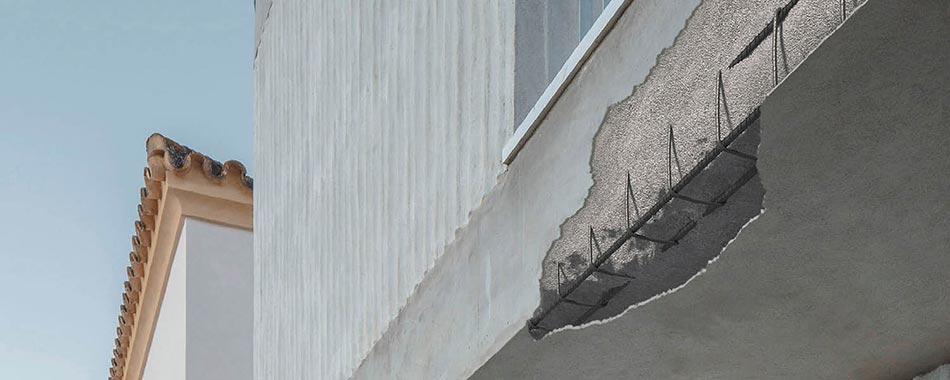
The degradation of concrete is usually initiated by the oxidation of the iron structure. Moisture enters through the concrete and when it reaches the iron of the structure, it rusts it. The rust causes the iron section to increase in volume, causing pressure from the inside that eventually breaks and detaches the iron-covering layer from the concrete.
The repair of this concrete has two phases:
1st.- Stabilisation of the iron: in the past, it was essential to mechanically remove all traces of rust. Reality showed us that this arduous task was not carried out with full efficiency, so that the repair did not have the expected effect. Today, the same rust is used to protect the iron of the structure. Current primers, such as FIX-REPAR ANTI-OXID or ANTI-OXID LIQUID, can be brushed directly onto the rust to stabilise it and thus prevent future corrosion. This method of protection is technically defined as anodic passivation.
FIX-REPAR ANTI-OXID dries to a blue-blackish colour within 3 hours after application.
2nd.- The regeneration of the detached concrete: once proper passivation of the iron has taken place, the concrete is regenerated. To do this we must use mortars specifically prepared for this task. They are mortars that meet a series of very important requirements: they must have high mechanical resistance, they must have controlled shrinkage, they must have a modulus of elasticity as similar as possible to that of concrete, they must be of an alkaline nature to protect the reinforcement, etc. Our FIX-REPAR product meets these specifications and many more: it has excellent adhesion, very high resistance to abrasion and is easy to work with, even without using form-work.
A good repair is one that focuses on prevention. For this reason, it is highly recommended to apply a protective paint as a finishing coat. It will prevent the entry of moisture into the concrete, its subsequent carbonation and further oxidation of the iron. It is a basic protection measure to achieve maximum durability in our reinforced concrete structures.