HOW TO WATERPROOF YOUR BATHROOM
In many European countries, it is already compulsory to waterproof the bathroom before tiling.
Why?
There are many cases in which water from the bath or shower runs through the wall and damp stains appear in the neighbour’s or our own wardrobe.
Can it be avoided?
Today it CAN be avoided. In contrast to the old solutions that were difficult, costly and time-consuming to apply, the latest advances in chemistry offer products that are very economical and practical for any construction worker to apply.
What do the regulations specify?
In this respect, the most advanced recommendations are those proposed by the ZDB Central Association of the German Construction Industry. They divide the presence of water into four classes:
Class I: Possible splashes of water over a short period of time.
Class II: Continuous presence of water without there being still water.
Class III: Outdoor buildings.
Class IV: Continuous presence of water without still water and with aggressive cleaning products and with high mechanical aggressions.
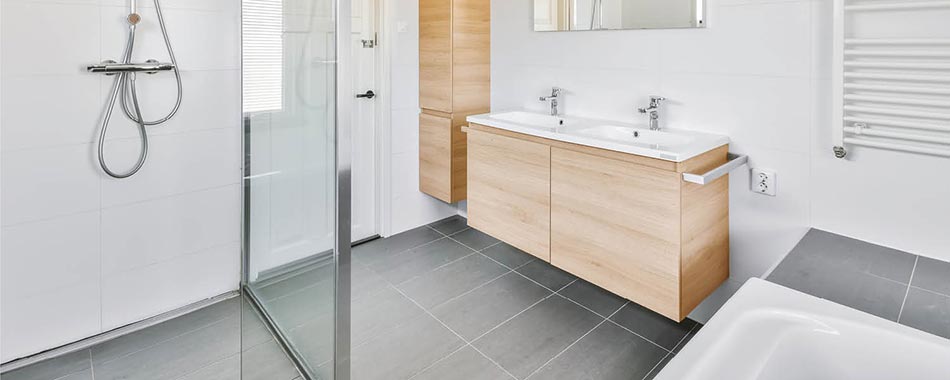
Our case corresponds to Class II: toilets, changing rooms, showers without ceramic tiles and sanitary premises in public and industrial areas with drains in the floor.
A new chemical breakthrough
The simplest and most practical solution is the one that combines a quick installation of the waterproofing product with perfect bonding of the tile adhesive and the ceramic tile. For this purpose, the possibilities offered by resin-based dispersion paints are the most suitable.
Technical requirements
Fortunately, the requirements for these products are on a par with those for bonding cements, so their reliability is guaranteed.
Good tensile strength is required to support ceramic tiles; sufficient elongation is required to be able to cover micro-cracks; and water impermeability and water vapour permeability are also required to prevent internal condensation from misting.
The Fixcer proposal
Four steps are recommended for this type of waterproofing and four products are proposed:
*priming of the absorbent bases as preliminary preparation: HIDROPRIMER
*protection of wall-floor junctions, pipe conduits, corners,… with ultra-elastic security tapes: FIX-BANDA
*two-coat application of the waterproof paint: HIDROFACIL
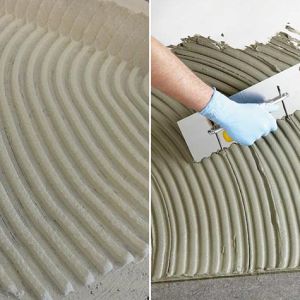
*bonding of ceramic tiles with flexible cement-based adhesives: FIXAFLEX GEL
These are prepared ready-to-use products. This prevents any problems due to incorrect dosage and the surplus will always be in perfect condition for the next waterproofing.